23 August Update:
The Summer 2006 issue (#65, Vol. 18, #2) has arrived in bookstores and letter boxes. So you'll want to scurry right down to your local dealer and grab one, settle down and take off for Old Guzzler, the Black Hole. (Right, Mom?)
Having great time in Haiti. back soon.
This issue of OnSpec and the story itself are reviewed on TangentOnline.
Wednesday, July 19, 2006


Monday, July 10, 2006
Tesseracts 9 Wins Aurora Award!
I'm pleased to learn that Tesseracts 9 has won the Aurora Award for Best Work in English (Other). My short story "The Coin" was published in this anthology. Yeehoo for us!
I look forward to checking out the other winners (and the short-list), especially Karin Lowachee's Cagebird, (Warner Aspect, Apr/2005), which won the award for Best Long-Form Work in English. For a brief chapter excerpt go to the Hachette Group's Excerpt site.
I look forward to checking out the other winners (and the short-list), especially Karin Lowachee's Cagebird, (Warner Aspect, Apr/2005), which won the award for Best Long-Form Work in English. For a brief chapter excerpt go to the Hachette Group's Excerpt site.
Congratulations, all!
Sunday, July 09, 2006
Back to Haiti...
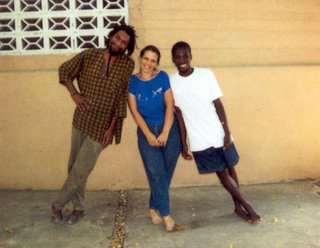
My first published story, "The Coin", was set in Cap Haitien, Haiti, where I lived four years ago. Another story, "Kouzen Zaka", set partly in Vancouver, Canada and partly in Haiti, is currently with a publisher. No word yet on its fate. In just over a week I will be travelling to Haiti for the fourth time, to visit friends in Cap Haitien, on the north coast, in a rural community in the mountains near Jacmel in the south, and finally in Port au Prince, the capital. While there I will be doing research for a third, as yet untitled, Haitian story.
I first went to Haiti in 2001, to visit a friend who had been living there for ten years. I have travelled only a little in my life, mostly in Canada and generally on the serious cheap--hitch-hiking away from the parental home at 13 to travel around the western half of the country as far north as the Yukon, trotting back and forth across Canada and jogging down to the States and Baja California in later years, and finally taking a six month circuit around Australia in 1985.
After leaving Australia I stopped off in New Zealand and Fiji. The entire trip was amazing, and changed my life in many ways. But Fiji was greatly set apart from the other countries in that this was the first time I was on my own in a non-European-based country and attempting to make some type of genuine contact with people of a very different culture. (Two cultures, actually--the indigenous Melanesian and the Fijian Indian.)
In the three weeks I was there I forced myself out of my normally shy and (in my estimation) unadventurous mode of living and befriended numerous people, finally taking a wild 14-hour trip in a small, wave-swept boat to a secondary island and going to meet the unsuspecting villagers, with whom I stayed for several days.
I made a lot of mistakes (some mistakes I postponed for later) and when I left the country I did so with a head full of questions and wonder. Strangely, the culture shock I had been warned about happened not when I was staying with the Fijian family I met on that smaller island, but when I returned to the culture I had been raised in, but never really felt a part of. This raised a lot more questions to mull for a decade or three.
The opportunity to go to Haiti sixteen years later was the next important step in attempting to see the world from a radically different point of view to the ones I grew up surrounded by.
I become slowly aware of the realities of life faced by people who live in ubiquitous poverty on a scale I could not grasp when simply viewing it on tv. I take in gradually the details of their complex and rich and brutal history and situation in the wider world, of nearly complete environmental devastation, of a religious mixture that affects and informs every level of life to a degree previously incomprehensible to me. I contemplate the effects of racism in me and on Haiti, the stubborn invisibility of my own cultural assumptions and prejudices, the degree of laughter and sharing and creativity and cooperation possible in me and the people around me.
I don't know how many times I will return to Haiti, how many stories I will be moved to write, how many lessons I will think I've learned that I will later overturn. But I am shaken alive in a thousand ways by my acquaintance with that land and her people, and I have a feeling I will never stop learning and deepening my love for her, and through her, for us all.
Whenever I write about Haiti, I write slowly and carefully, knowing that my ignorance far outweighs my knowledge, wanting to make of each story a gift not only to us, but to her. So I listen, I watch, I hold my tongue and I question every conclusion I want to jump to. I treasure each dull and painful and happy moment I spend in, or thinking of, Haiti. I can only hope that the following encouraging proverb is true in the case of her and me:
Si ou gen pasyans, ou ka wè trip fomí.
If you have patience,
you can see the guts of an ant.
you can see the guts of an ant.
That's pretty darn teeny. And pretty darn neat.
Be well, all. See you at VCon 31.
the photo above is of the members of DOA/BN, a Haiti-based group that teaches cultural awareness, history, and a host of other things to groups living in and travelling to Haiti.
At DOA/BN, we strive to be a bridge for those who have adventured into Haiti, experienced new sensations, and have been opened up to new realities.
Haiti's deep roots, wrenching history, and compelling truths will offer you gifts of new understandings. Our vision is to connect you with Haiti's people and history, allowing you to capture the community of their shared daily lives through intercultural experiences.
They are some cool folk. Check out their website, Haiti Travels.
PS BLogger makes me crazy. I have tried to correct the font about ten thousand times. I am now going to retire to bed with mouse-wheel tendonitis. Cheers.
the photo above is of the members of DOA/BN, a Haiti-based group that teaches cultural awareness, history, and a host of other things to groups living in and travelling to Haiti.
At DOA/BN, we strive to be a bridge for those who have adventured into Haiti, experienced new sensations, and have been opened up to new realities.
Haiti's deep roots, wrenching history, and compelling truths will offer you gifts of new understandings. Our vision is to connect you with Haiti's people and history, allowing you to capture the community of their shared daily lives through intercultural experiences.
They are some cool folk. Check out their website, Haiti Travels.
PS BLogger makes me crazy. I have tried to correct the font about ten thousand times. I am now going to retire to bed with mouse-wheel tendonitis. Cheers.
Monday, June 05, 2006
The Storm Behind the Lull
It's been quite awhile since I posted to this blog. Not a lot announcement-wise. One story accepted by On Spec magazine (After Hours at the Black Hole), and that's it. Truth to tell, I have fallen behind a little on sending stories out, being much more interested in writing than in drumming up markets. But I have not been idle. I continue to attend a weekly writers' workshop, which gets my juices flowing if they weren't already, and have finished about 14 stories in the last two years.
However, I confess that at this moment there are other pursuits that are grabbing my attention more. Preparing to travel is foremost among them. So if I seem neglectful, it is benign neglect. And there is much activity behind the apparent quiet.
Cheers.
However, I confess that at this moment there are other pursuits that are grabbing my attention more. Preparing to travel is foremost among them. So if I seem neglectful, it is benign neglect. And there is much activity behind the apparent quiet.
Cheers.
Thursday, February 02, 2006
Mike Coney Interview Published

Strange Horizons has published my interview of the late SF writer Mike Coney. Check this link to read it.
Wednesday, February 01, 2006
Tesseracts 9 Recommended
Word from the publisher:
Hi,
Please pass the word on to anyone you know!
Tesseracts 9 makes the LOCUS Recommended reading list.
Look in the Anthologies section!
Also note also that "Mayfly", by Peter Watts & Derryl Murphy makes it on
to the Short Story list!
http://www.locusmag.com/2006/Issues/02RecommendedReading.html
Three Cheers to everyone involved!!
Brian Hades, Publisher (http://www.edgewebsite.com)
Box 1714, Calgary, AB, T2P 2L7, Canada
403-254-0160 (voice) / 403-254-0456 (fax)
EDGE Science Fiction and Fantasy Publishing now includes Tesseract Books
--------------------------------------------------------
New Releases:
Eclipse by K. A. Bedford
(978-1-894063-30-2)
5.5" x 8.5" - Trade Paperback
$14.95 US - 19.95 CD - 309 Pages
A Game of Perfection by Élisabeth Vonarburg
(978-1-894063-32-6)
5.5" x 8.5" - Trade Paperback
$16.95 US - 20.95 CD - 360 Pages
Stealing Magic by Tanya Huff
(978-1-894063-34-0)
5.5" x 8.5" - Trade Paperback
$13.95 US - 16.95 CD - 256 Pages
Hi,
Please pass the word on to anyone you know!
Tesseracts 9 makes the LOCUS Recommended reading list.
Look in the Anthologies section!
Also note also that "Mayfly", by Peter Watts & Derryl Murphy makes it on
to the Short Story list!
http://www.locusmag.com/2006/Issues/02RecommendedReading.html
Three Cheers to everyone involved!!
Brian Hades, Publisher (http://www.edgewebsite.com)
Box 1714, Calgary, AB, T2P 2L7, Canada
403-254-0160 (voice) / 403-254-0456 (fax)
EDGE Science Fiction and Fantasy Publishing now includes Tesseract Books
--------------------------------------------------------
New Releases:
Eclipse by K. A. Bedford
(978-1-894063-30-2)
5.5" x 8.5" - Trade Paperback
$14.95 US - 19.95 CD - 309 Pages
A Game of Perfection by Élisabeth Vonarburg
(978-1-894063-32-6)
5.5" x 8.5" - Trade Paperback
$16.95 US - 20.95 CD - 360 Pages
Stealing Magic by Tanya Huff
(978-1-894063-34-0)
5.5" x 8.5" - Trade Paperback
$13.95 US - 16.95 CD - 256 Pages
Friday, January 27, 2006
"After Hours at the Black Hole" Accepted
i got the pleasing news today that On Spec has accepted my story "After Hours at the Black Hole". i'll pass on the issue number and so on when that is settled. the scoop so far is that it will be used within the next two years.
Wednesday, January 18, 2006
What's Available, What's Not...Yet
the following postings are the backbone of this blog, so you might want to check them out, besides reading the latest postings. i do add material to these as it comes up--such as when i finish a story. (see "Traversing the Wilderness.")
Currently Available Work
UpCominG PubLIcationS
Works Looking for a Home
Old Stuff I Wrote Back When
Running Mates--Others in the Pack
Currently Available Work
UpCominG PubLIcationS
Works Looking for a Home
Old Stuff I Wrote Back When
Running Mates--Others in the Pack
Potlatch 15
i'll be venturing down to seattle to Potlatch 15 the last weekend of february. i am very much looking forward to it. it is a small con that is oriented toward readers and writers, and serves as a fundraiser for the clarion west writers' workshops. this year the book under discussion is the Avram Davidson Treasury. imagine a con where everybody has read and is talking about the same book...
and i bet you would, too, dear reader.
here is a note i sent a few moments ago, on the book selection:
hi!
when i come across something i really like i often do a brief scan of who i think might also enjoy it, and your name has just popped up.
i'm reading the book chosen for discussion at this year's Potlatch (Potlatch 15), which you may or may not know is a small readercon held in seattle in february. it's my first time there and i'm psyched to be going to a con where books are very much of interest. anyway, off track here.
the book is the Avram Davidson Treasury, and although i've read a few of his stories over time--most notable "The Golem", which i liked so much i read it to a couple of friends subsequently--i have never had a concentrated dose of this brilliant man's writing before. brilliant and zany, erudite, often hilarious. i've just finished one where a dentist is kidnapped by aliens and must be saved by colleagues in the american dental association. sounds ridiculous but reads wonderfully. ("Help! I am Dr. Morris Goldpepper")
based on what i've read of your stuff, i think you would really enjoy Avram's stories.
cheers,
casey
and i bet you would, too, dear reader.
Mike Coney Interview
happily, my interview of Mike Coney, completed shortly before his death on 4 november 2005, has been accepted for publication by Strange Horizons. i will update this notice with the publication date and url when the time comes.
Friday, November 25, 2005
A Thought on the Word "Cinematic"
at my writing group last week i read from a story i am working on, currently titled "Thunderbird Refugee". one woman said how cinematic my description was. this was a compliment, of course, so i was surprised that i felt a little uncomfortable. it took a couple of days for the reason to rise into my consciousness.
when i wrote the piece, i was doing what i normally do, which is to envision the place and characters i was describing. much of that draws on memory, times when i have walked along a forest trail, or seen spaceships crash in the wilderness. (okay, maybe not that.) it had nothing to do with movies--although i can also remember times when i have been writing that i absolutely was envisioning a scene from a film--real or created at that moment in my mind. i suppose to a reader there might not be a difference, but when i am writing, there is--a difference in what i am seeing in my mind's eye, and also a difference in how i am relating to the story and it's characters. it is generally a more remote relationship, more interested in outward form than inward reality.
a film is something i watch and respond to, which, however wonderful, is artificial and intentional. as i watch it, i know that i'm seeing the scene before me for a reason. it is meant to tell me something, to set up a particular reaction, to drive the tale forward in some way.
when i am walking in the woods, sitting with a friend, or otherwise just going through life, i am seeing and observing (more or less attentively) but there is no particular "reason" for all that unfolds before me, and to me, it's meaningful in a very different way. it is simply the life i live and the world i respond to.
what disturbed me when she used the word "cinematic" was that it gave me the distressing image of us only really seeing vividly what is before us when it's put up on a screen and we know it's our job now to look. that otherwise we are wandering through the much richer world of actual life without really looking at it. that, in a way, we need movies to remind us to open our eyes--but what we are opening them onto isn't what is real, and necessary for our lives. a frightening thing.
it surprises me, actually, how much i remember of what i've seen, for all the days i have spent with my attention more firmly fixed on the inside of my head or the thing i am intending to do than on what is around me. it's a real gift to have the chance in writing, or in some other pursuit, to cast my mind back over a situation, no matter how mundane, and see any of the details of it in absolute clarity. it has taught me to keep my eyes peeled much more carefully, much more of the time, to see what there is right now and respond to it--or him or her--rather than only to the plan i have roiling in my head. (i've learned to do this more of the time, but far from all of it.)
i suppose the discomfort is simply loyalty to that gift of goal-lessness, of seeing whatever is, without purpose or intent. later, we can make stories of it if we like. but now, the joy is simply in getting to look. and the greater joy is in getting to learn from all that is offered, rather than having it neatly packaged before we open our eyes.
when i wrote the piece, i was doing what i normally do, which is to envision the place and characters i was describing. much of that draws on memory, times when i have walked along a forest trail, or seen spaceships crash in the wilderness. (okay, maybe not that.) it had nothing to do with movies--although i can also remember times when i have been writing that i absolutely was envisioning a scene from a film--real or created at that moment in my mind. i suppose to a reader there might not be a difference, but when i am writing, there is--a difference in what i am seeing in my mind's eye, and also a difference in how i am relating to the story and it's characters. it is generally a more remote relationship, more interested in outward form than inward reality.
a film is something i watch and respond to, which, however wonderful, is artificial and intentional. as i watch it, i know that i'm seeing the scene before me for a reason. it is meant to tell me something, to set up a particular reaction, to drive the tale forward in some way.
when i am walking in the woods, sitting with a friend, or otherwise just going through life, i am seeing and observing (more or less attentively) but there is no particular "reason" for all that unfolds before me, and to me, it's meaningful in a very different way. it is simply the life i live and the world i respond to.
what disturbed me when she used the word "cinematic" was that it gave me the distressing image of us only really seeing vividly what is before us when it's put up on a screen and we know it's our job now to look. that otherwise we are wandering through the much richer world of actual life without really looking at it. that, in a way, we need movies to remind us to open our eyes--but what we are opening them onto isn't what is real, and necessary for our lives. a frightening thing.
it surprises me, actually, how much i remember of what i've seen, for all the days i have spent with my attention more firmly fixed on the inside of my head or the thing i am intending to do than on what is around me. it's a real gift to have the chance in writing, or in some other pursuit, to cast my mind back over a situation, no matter how mundane, and see any of the details of it in absolute clarity. it has taught me to keep my eyes peeled much more carefully, much more of the time, to see what there is right now and respond to it--or him or her--rather than only to the plan i have roiling in my head. (i've learned to do this more of the time, but far from all of it.)
i suppose the discomfort is simply loyalty to that gift of goal-lessness, of seeing whatever is, without purpose or intent. later, we can make stories of it if we like. but now, the joy is simply in getting to look. and the greater joy is in getting to learn from all that is offered, rather than having it neatly packaged before we open our eyes.
Monday, November 14, 2005
Stories of Our Life
i feel like a dope when i claim to like--and even write--speculative fiction, and then i am asked, "which authors do you like?" and i stumble a bit.
the problem is that i read more short fiction than long, generally in magazines, though sometimes in anthologies, very seldom single author collections, and unless i have met the person or have read several stories by them--which can take a while using this random method--then both the authors' and the stories' names tend to dribble out my brain, despite my trying to keep them in. it's frustrating because when i come across a story that i just love, and i want to remember so that i can catch that author again, and so i can let people know about them.
so i am going to jot down a couple of the stories from that last couple of years of reading that i have liked and which i still have on my shelf (problem two--i pass on my magazines when i am done with them, thus giving each writer several more readers to a piece--which means i can't thumb through and remind myself of their names), as well as a couple that have lodged themselves in my head long term.
one of the best stories i have ever read is by the very amazingly NOT prolific ted chiang(yay ted!)--"The Story of Your Life"--which i first read in a hartwell "best" anthology, nestled in a chilly cabin in rural b.c. a year or two back. ted has gathered together several other of his peculiar and fascinating stories in his collection The Stories of Your Life and Others. a couple of those stand out, too, in particular the one about building the tower of babylon.
a story i got a kick out of in one of those "best" anthologies in that (by then hopefully warmed up) room was "Craphound", by cory doctorow. this one still brings a smile.
barth anderson's Magnifico the Crimson won my heart in "Lark Till Dawn, Princess", from Mojo: Conjure Stories, ed. nalo hopkinson.
from F & SF in 2004, i most enjoyed daryl gregory's "The Continuing Adventures of Rocket Boy", george guthridge's "Nine Whispered Opinions Regarding the Alaskan Succession, robert reed's "The Condor's Green-Eyed Child", and most especially alex irvine's "A Peacable Man". (i know because i kept the 2004 index when i passed on the magazines. good plan, that.) although i have to say that my interest in F & SF is flagging, as the bulk of its stories don't hugely grab me and i miss there being more women's voices in the mix.
Tesseracts 9, which i read with great interest, for obvious reasons, had a number of stories i liked. the two that really stand out are dan rubin's "The Singing" and alette willis' "Thought & Memory".
two examples of stories in Neo-Opsis that i have enjoyed: "Thirty-Three", by tom brennan & "The Rain Queen", by barbara davies.
cjw
the problem is that i read more short fiction than long, generally in magazines, though sometimes in anthologies, very seldom single author collections, and unless i have met the person or have read several stories by them--which can take a while using this random method--then both the authors' and the stories' names tend to dribble out my brain, despite my trying to keep them in. it's frustrating because when i come across a story that i just love, and i want to remember so that i can catch that author again, and so i can let people know about them.
so i am going to jot down a couple of the stories from that last couple of years of reading that i have liked and which i still have on my shelf (problem two--i pass on my magazines when i am done with them, thus giving each writer several more readers to a piece--which means i can't thumb through and remind myself of their names), as well as a couple that have lodged themselves in my head long term.
one of the best stories i have ever read is by the very amazingly NOT prolific ted chiang(yay ted!)--"The Story of Your Life"--which i first read in a hartwell "best" anthology, nestled in a chilly cabin in rural b.c. a year or two back. ted has gathered together several other of his peculiar and fascinating stories in his collection The Stories of Your Life and Others. a couple of those stand out, too, in particular the one about building the tower of babylon.
a story i got a kick out of in one of those "best" anthologies in that (by then hopefully warmed up) room was "Craphound", by cory doctorow. this one still brings a smile.
barth anderson's Magnifico the Crimson won my heart in "Lark Till Dawn, Princess", from Mojo: Conjure Stories, ed. nalo hopkinson.
from F & SF in 2004, i most enjoyed daryl gregory's "The Continuing Adventures of Rocket Boy", george guthridge's "Nine Whispered Opinions Regarding the Alaskan Succession, robert reed's "The Condor's Green-Eyed Child", and most especially alex irvine's "A Peacable Man". (i know because i kept the 2004 index when i passed on the magazines. good plan, that.) although i have to say that my interest in F & SF is flagging, as the bulk of its stories don't hugely grab me and i miss there being more women's voices in the mix.
Tesseracts 9, which i read with great interest, for obvious reasons, had a number of stories i liked. the two that really stand out are dan rubin's "The Singing" and alette willis' "Thought & Memory".
two examples of stories in Neo-Opsis that i have enjoyed: "Thirty-Three", by tom brennan & "The Rain Queen", by barbara davies.
a story in Asimov's september issue that i really liked was another by daryl gregory--"Second Person, Present Tense." so i am glad i wrote this list. it lets me know that of the stories i have read in the last year or so, two favourites are by the same guy. A Name To Watch For.
finally, the story i just finished reading that inspired me to write this posting today is from an old issue of On Spec (spring 1997), and is "Chad", by kate riedel. just lovely.so now i know what to say when asked who i like. "well, in addition to certain novelists i enjoy, eileen kernaghan, mike coney, nalo hopkinson, to name a few, there is some great short work by writers like daryl gregory and ted chiang, kate riedel and robert reed, dan rubin and alette willis... why, i could just go on and on..."
cheers.cjw
Friday, November 04, 2005
Hello, Mike--Goodbye...
Mike Coney died this morning at about 4 a.m.. Thankfully, it was not as painful and difficult a process as had been feared. Science Fiction has lost an intelligent and lively writer.
A few weeks before he died, I interviewed Mike--that interview is currently with a publisher awaiting acceptance. For the moment I will offer this small excerpt here.
Mike: The whole matter of the Celestial Steam Locomotive arose out of boredom with standard SF, which up to that point, I had written. It was an attempt to write a story in which absolutely anything could and did happen, driven only by the mentalities of the people involved. I felt it succeeded in these terms but I don’t consider it an easy book to read and I have had a few adverse comments on it from people who simply don’t know what I was getting at. This was why I went on to write Fang, which I knew would be much easier for the reader to follow. I think it’s very easy for a writer to get too clever for his own damn good and to forget that his business is to entertain his readers. I’ve seen it happen to many other writers and now I could see it happening to myself. It was not what I wanted. The subsequent story on the website, The Flower of Goronwy is an attempt to return to the style and characters of my earlier books including Susanna and adding a touch of spice by the use of a truly horrifying heroine, Mistrale.
Casey: If you were to write a novel now, what would it look like? What theme, what setting, what mood would it strike?
Mike: If I wrote a novel now I think it would turn out to be like Flower of Goronwy. In fact, I think it has done.
A few weeks before he died, I interviewed Mike--that interview is currently with a publisher awaiting acceptance. For the moment I will offer this small excerpt here.
Mike: The whole matter of the Celestial Steam Locomotive arose out of boredom with standard SF, which up to that point, I had written. It was an attempt to write a story in which absolutely anything could and did happen, driven only by the mentalities of the people involved. I felt it succeeded in these terms but I don’t consider it an easy book to read and I have had a few adverse comments on it from people who simply don’t know what I was getting at. This was why I went on to write Fang, which I knew would be much easier for the reader to follow. I think it’s very easy for a writer to get too clever for his own damn good and to forget that his business is to entertain his readers. I’ve seen it happen to many other writers and now I could see it happening to myself. It was not what I wanted. The subsequent story on the website, The Flower of Goronwy is an attempt to return to the style and characters of my earlier books including Susanna and adding a touch of spice by the use of a truly horrifying heroine, Mistrale.
Casey: If you were to write a novel now, what would it look like? What theme, what setting, what mood would it strike?
Mike: If I wrote a novel now I think it would turn out to be like Flower of Goronwy. In fact, I think it has done.
Sunday, October 30, 2005
Thursday, October 20, 2005
Pals Doing Well
Eileen Kernaghan's Alchemist's Daughter has been nominated for a Saskatchewan Book Award--however, every time i try to write all this in and put links and such it all disappears, so if you are interested, do a search yourself! Meanwhile, this DOES bring to four the nominations for this book--Nominated for the 2005 Sheila A. Egoff Children's Literature Prize. Nominated for the 2006 Manitoba Young Readers' Choice Award. Short-listed for the 2005 Canadian Science Fiction and Fantasy Award, the Aurora, for best long-form work in English.
And Gail Nyoka has been nominated for a Governor General's Award for her book Mella and the N'anga, an African Tale. weird things keep happening to destroy this entry, too, so if no links show up go ahead and do a search on the book and the awards. i don't dare try again here!
And Gail Nyoka has been nominated for a Governor General's Award for her book Mella and the N'anga, an African Tale. weird things keep happening to destroy this entry, too, so if no links show up go ahead and do a search on the book and the awards. i don't dare try again here!
Friday, September 30, 2005
Coming in from the Rain
well, it's begun--that beautiful wet cool that slides so easily into monotonous grey. strangely, i love this time of year. i don't have to feel guilty about staying in writing instead of enjoying the sun. it's easy to find my cats at night. (who wants to be out in that?) i feel baking urges (womanfully resisted), and my weekly writers' workshop starts up again.
yesterday was our second class for the season, and i was so juiced when i got home i fixed up the story i'd just workshopped, and then spent several hours packaging up new and returned stories for their next travel adventure. so basically the entire day was spent with writing-related work. i even decided to write a story especially for a submissions call i had received a couple of months ago but had nothing for. normally i would just forget it, but this one kept coming back to me, so i finally gave in to the Call. i figured i would get to it today.
well, but, my little brain started turning over the subject matter as i lay snuggled in bed, waiting for sleep to come. and the more i poked at the soil the more material i found to work with, and the next thing you know i was hauling my butt back out of bed (at 20 after 12) and turning the computer back on, sore arms and all, and for the next three hours just poured myself into the story. i've posted a little excerpt of Claude and the Henry Moores. you can find it by peeking below this entry, at ~Den Keeping~, or by following this link: Traversing the Wilderness: Works In Circulation.
i am like the guy in the story. i don't like staying up all night. but this time it was no problem at all. i was so swept away with the story that sleep didn't come even long after i was done. what a wonderful experience. of course, i was a little woozy today when i got up and started the second draught, but that was a small sacrifice for the joy of writing so enthusiastically, and being so happy with the result.
tonight, though, maybe i'll crash a little earlier...
cheers!
cjw
yesterday was our second class for the season, and i was so juiced when i got home i fixed up the story i'd just workshopped, and then spent several hours packaging up new and returned stories for their next travel adventure. so basically the entire day was spent with writing-related work. i even decided to write a story especially for a submissions call i had received a couple of months ago but had nothing for. normally i would just forget it, but this one kept coming back to me, so i finally gave in to the Call. i figured i would get to it today.
well, but, my little brain started turning over the subject matter as i lay snuggled in bed, waiting for sleep to come. and the more i poked at the soil the more material i found to work with, and the next thing you know i was hauling my butt back out of bed (at 20 after 12) and turning the computer back on, sore arms and all, and for the next three hours just poured myself into the story. i've posted a little excerpt of Claude and the Henry Moores. you can find it by peeking below this entry, at ~Den Keeping~, or by following this link: Traversing the Wilderness: Works In Circulation.
i am like the guy in the story. i don't like staying up all night. but this time it was no problem at all. i was so swept away with the story that sleep didn't come even long after i was done. what a wonderful experience. of course, i was a little woozy today when i got up and started the second draught, but that was a small sacrifice for the joy of writing so enthusiastically, and being so happy with the result.
tonight, though, maybe i'll crash a little earlier...
cheers!
cjw
Friday, September 16, 2005
Pallahaxi Mike

 A long time ago an alien virus infected my brain and I gave up science fiction and got Serious. I didn't get serious and start reading Classical Literature, or improving my mind with CanLit. No, I got serious and stopped reading fiction altogether unless it was written by a friend or there was something specific I wanted to glean from it or—and it did happen from time to time—I fell off the wagon, took a holiday, grabbed some willing novel and read.
This is a frightening admission but it saves me pretending to be better read than I am, and it explains why it was only this summer that I realized I had never read a thing by Mike Coney and decided to do something about it. I went to his website to get a sense of where to begin, and discovered to my puzzled delight that he had made three novels and five short stories available there for free. I downloaded one, realized it was a sequel, got ahold of the original, and have since drunk with heady pleasure the fine wine of Michael's prose. What I have been missing!
The books are Pallahaxi Tide (first published in England as Hello Summer, Goodbye, and released in the United States as Rax) and I Remember Pallahaxi. Although they are related, they can be read separately and are fine and satisfying novels on their own. But for the greatest pleasure I recommend reading them both.
What to say about them, without giving too much away?
My first impression of Pallahaxi Tide was that it was a quirky fantasy novel set in a primitively industrial world that sounded a lot like my idea of England in earlier days. In fact, both books are solid and thoroughly-imagined science fiction. Yet the fantasy impression isn't entirely misplaced. There is a lushness to the world and an accessibility and occasional humour that seem to my poorly-read mind to be more common in fantasy than in sf. The humour in no way detracts from the seriousness of the story, but simply makes the narrators more endearing and keeps the SerCon* Virus at bay. It is a familiar, self-deprecating and dry humour that greatly appeals to me.
"I was sitting on the stern thwart, holding the tiller, while Wolff sat amidships grasping the mainsheet. We had reached the outer harbour and were running out of the shelter of the cliffs; the breeze was freshening, driving us briskly towards the lighthouse at the end of the breakwater. The water was a little choppy here and every so often a wave slopped over the low gunwales....
"...As I shifted position a river of icy water soaked my foot and cold fear ran up my leg. We were sinking. The water was freezing cold. I looked frantically around for help. We were many paces from the nearest boat, doomed to death from exposure preceded by the terrible onset of insanity as the coldness of the water gradually chilled our bodies and froze our brains.
"Having faced the worst I was able to devote my attention to more practical matters. "
pp.42-43
In Pallahaxi Tide, we meet Drove and Browneyes, young people from different villages and very different stations in life. Drove is the son of a low-ranking official who busies himself with secret machinations while the scornful son befriends the low-class daughter of local inkeepers. As the story unfolds, the scope of the threat facing the people of this place, an Earth-like planet caught in a complicated dance with a star and its gas giant partner, becomes clear to the young people involved, and the choices they must make cut deep and irrevocably. Coney has realized the characters and plot completely, and treated us throughout to visions of an alien seasonal round and life-forms that surprise and delight.
One thing only disappointed me, and this is more than rectified in the following book, I Remember Pallahaxi. That is, the nature of the lorin.
The lorin are gentle and silent creatures that drift along the back edges of existence in the first book, intruding only occasionally in unexpected ways, without ever being really explained. In book two it is all gradually revealed, and the second book, though very different than the first, is if anything even more satisfying.
So now that I am hooked, a confirmed Coney fan, what do I do?
Well, it's tricky. Mike has written a good number of books and short stories, but the height of his popularity was in the 70's. As with so many excellent writers, as the trends in publishing changed, it became harder for him to find publishers for his work, and as a result it is not so easy to find these days. A number of copies of some of his novels are available via the internet (BookFinder has a healthy listing: http://www.bookfinder.com/), and others may be found in libraries and used book stores. But again, being softcovers, those library copies do tend to wear out, and go astray—as I discovered when ordering the English version of book one from the Vancouver Library.
It's worth the effort to look. And there are those offerings at his site. I certainly intend to slurp them up:
http://www.members.shaw.ca/mconey/
*SerCon (or sercon): Serious & Constructive. Important & Good (but if you ask me, dangerous if taken in too great quantities.) Usually refers to Fannish Activity (fanac), but also to the literature itself. I have expanded somewhat on its meaning here.
Tuesday, August 23, 2005
Good Review in Quill & Quire
I was forwarded this sneak preview of the Quill & Quire review of Tesseracts 9, in which (YAY!) "The Coin" is mentioned:
"Nalo Hopkinson and Geoff Ryman selected 23 of the best recent works of Canadian speculative short fiction and poetry, from both established and emerging writers, moulding an anthology that places the genre firmly alongside fantastical satirists such as Gogol and Bulgakov while also pushing the genre's boundaries.
"Ryman opens the anthology with a spirited essay that rejects notions of national identity in favour of the argument that Canada has become a universal, and therefore useful, venue for speculative fiction, concluding that Tesseracts Nine proves that there is no such thing as Canadian fantasy and science fiction. Hopkinson closes the book pondering what makes this speculative fiction Canadian and concludes that it's the work's diversity, concern for community, and abundance of humour.
"Many selections are enthralling: the fairy-tale quality of "The Coin" by Casey June Wolf, the suspense of Elizabeth Vonarburg's "See Kathryn Run," the touching hilarity of Candas Jane Dorsey's "Mom and Mother Teresa." But the fashionable modern excerpts from "Fugue Phantasmagorical," by Anthony MacDonald and Jason Mehmel, dispersed throughout the anthology left me cold. So, too, did the poetry selections.
"But no piece in Tessearcts Nine misses its mark completely. Artist and comic writer E. L. Chen's "Fin-de-siecle" is a well-crafted and entirely humane vampire story, while "The Writing on the Wall," by Steve Stanton, tells the tragic tale of the unexceptional midlife crisis of an exceptional man. on a similar Kafkaesque note, Claude Lalumiere's "Being Here" takes the theme of the man estranged from his partner to a thought-provoking and heart-wrenching end.
"Particularly touching is Newfoundland musician Dan Rubin's "The Singing," a beautiful and vivid account of an elderly woman inadvertently saving the planet by drumming and singing as she nears death. Aliens, poised to demolish much of the Earth of make it fit for colonization, are so moved by the song that they leave peacefully, while broadcasting it to all known frequencies in the universe. I wish no less a hearing for the Canadian writing presented in this delectable anthology.
" --Tracey Thomas, a writer and reviewer in Toronto. Page 36, Sept 2005"
"Nalo Hopkinson and Geoff Ryman selected 23 of the best recent works of Canadian speculative short fiction and poetry, from both established and emerging writers, moulding an anthology that places the genre firmly alongside fantastical satirists such as Gogol and Bulgakov while also pushing the genre's boundaries.
"Ryman opens the anthology with a spirited essay that rejects notions of national identity in favour of the argument that Canada has become a universal, and therefore useful, venue for speculative fiction, concluding that Tesseracts Nine proves that there is no such thing as Canadian fantasy and science fiction. Hopkinson closes the book pondering what makes this speculative fiction Canadian and concludes that it's the work's diversity, concern for community, and abundance of humour.
"Many selections are enthralling: the fairy-tale quality of "The Coin" by Casey June Wolf, the suspense of Elizabeth Vonarburg's "See Kathryn Run," the touching hilarity of Candas Jane Dorsey's "Mom and Mother Teresa." But the fashionable modern excerpts from "Fugue Phantasmagorical," by Anthony MacDonald and Jason Mehmel, dispersed throughout the anthology left me cold. So, too, did the poetry selections.
"But no piece in Tessearcts Nine misses its mark completely. Artist and comic writer E. L. Chen's "Fin-de-siecle" is a well-crafted and entirely humane vampire story, while "The Writing on the Wall," by Steve Stanton, tells the tragic tale of the unexceptional midlife crisis of an exceptional man. on a similar Kafkaesque note, Claude Lalumiere's "Being Here" takes the theme of the man estranged from his partner to a thought-provoking and heart-wrenching end.
"Particularly touching is Newfoundland musician Dan Rubin's "The Singing," a beautiful and vivid account of an elderly woman inadvertently saving the planet by drumming and singing as she nears death. Aliens, poised to demolish much of the Earth of make it fit for colonization, are so moved by the song that they leave peacefully, while broadcasting it to all known frequencies in the universe. I wish no less a hearing for the Canadian writing presented in this delectable anthology.
" --Tracey Thomas, a writer and reviewer in Toronto. Page 36, Sept 2005"
Monday, August 22, 2005
Those Lazy, Hazy, Science-Fictiony Days of Summer
As promised, I have concentrated on reading more than writing this summer but, hey, some stories can't be stopped.
Two weeks ago, "After Hours at the Black Hole" came to be (from out of a White Hole, as far as I can tell). It seems like science fiction but I was in too playful a mood to worry about it too much—you can trust the info on black holes but forget details such as how spaceships function in space and how can you get close enough to do that anyway, and so on. I really had fun writing this one, and it's begun making The Rounds. Eileen Kernaghan tells me it is metaphysical and I believe her. She also tells me that a lot of what I write is slipstream, which she further informs me is fiction that slips between genres. Sounds accurate. By the way, Eileen's wonderful book, Winter on the Plain of Ghosts (one of my favourites last year), has been mentioned at length on Challenging Destiny in James Schellenberg's article on Jared Diamond's Collapse, about collapsing civilizations. Very interesting article all round. (See his review of WoPG, also in C.D.)
No sooner had "After Hours at the Black Hole" taken care of itself when I found myself writing another, then unnamed story. "Equals" is pure science fiction, drawing on my interest in biology and ecology, with a lot of boning up on the specifics to carry me through.
Although I do draw on science in my writing at times, I don't often write a story that would be zilch without the science. "Equals" is one, and it is for me a very weird way to write, yet extremely satisfying. I am itching to give everything away but I'll control myself. At the moment, it's off with the experts—a biologist with a special interest in the field covered (Terry), and my favourite literary advisor (Eileen). We'll see what they say and then fiddle with it a little more before sending out. (30 Aug.: got the thumbs up from the pros--off she goes, then.) For sneak previews of these and other stories, click here: Traversing the Wilderness: Works In Circulation
The next couple of weeks will have to be about reading more than writing, especially considering a five-day jaunt to Atlanta. I have a sliver of Jack Whyte's Skystone left, and then on to Andre Norton's Catseye and this pile of neglected short stories--Neo-Opsis Magazine, which I've just subscribed to, Asimov's, and a heap of F & SF.
When I was twelve years old, I had been avoiding reading science fiction despite my mother's interest in the genre (she gave me Tom Swift and His Jetmarine when I was eight or so) because I had heard disparaging things said about it and didn't want to be seen to be unsophisticated. On the other hand, Pippi Longstocking and so on were not really turning my crank, as I was led to believe they would.
One day, I saw a book called Catseye—I was already wise enough to be deeply fond of cats—and my resistance was gone. I slid it off the school library shelf, brought it home, and was ushered wide-eyed into a world I have never since wanted to leave. (Although, for a time I did. Within a few months of Catseye I had read Les Miserables, and went on to various other depressing tomes for several years until I finally realized literature was Not Much Fun, and I'd rather be unsophisticated. At seventeen, it was Andre Norton again, with her Witch World series, that booted me back to where I belong.)
As you probably know, Andre Norton died this past St. Patrick's Day. I decided, as a tribute to her and in celebration of my renewed writing of speculative fiction and re-energized joy in reading, that I would reread the book that started me off. So Troy Horan and his special animal sensitivity are waiting beside my bed, and I am greatly looking forward to leaping in. To the book. Not into bed with Troy. Don't misunderstand me.
The last Must Read this summer is Mike Coney's I Remember Pallahaxi, which I have downloaded from his site. I read and much enjoyed Pallahaxi Tide (also known as Rax in the U.S. and Hello Summer, Goodbye in England) and am looking forward very much to reading the Long-Awaited Sequel. I accidentally named the planet in "Equals" after creatures in that book—the lorin—and when I made the connection, was pleased and let it stick.
For those who are aware of Mike's illness, the word is that he is doing well at the moment and things are progressing more slowly than they might. Which is good news all around.
Happy reading and writing!
casey
Two weeks ago, "After Hours at the Black Hole" came to be (from out of a White Hole, as far as I can tell). It seems like science fiction but I was in too playful a mood to worry about it too much—you can trust the info on black holes but forget details such as how spaceships function in space and how can you get close enough to do that anyway, and so on. I really had fun writing this one, and it's begun making The Rounds. Eileen Kernaghan tells me it is metaphysical and I believe her. She also tells me that a lot of what I write is slipstream, which she further informs me is fiction that slips between genres. Sounds accurate. By the way, Eileen's wonderful book, Winter on the Plain of Ghosts (one of my favourites last year), has been mentioned at length on Challenging Destiny in James Schellenberg's article on Jared Diamond's Collapse, about collapsing civilizations. Very interesting article all round. (See his review of WoPG, also in C.D.)
No sooner had "After Hours at the Black Hole" taken care of itself when I found myself writing another, then unnamed story. "Equals" is pure science fiction, drawing on my interest in biology and ecology, with a lot of boning up on the specifics to carry me through.
Although I do draw on science in my writing at times, I don't often write a story that would be zilch without the science. "Equals" is one, and it is for me a very weird way to write, yet extremely satisfying. I am itching to give everything away but I'll control myself. At the moment, it's off with the experts—a biologist with a special interest in the field covered (Terry), and my favourite literary advisor (Eileen). We'll see what they say and then fiddle with it a little more before sending out. (30 Aug.: got the thumbs up from the pros--off she goes, then.) For sneak previews of these and other stories, click here: Traversing the Wilderness: Works In Circulation
The next couple of weeks will have to be about reading more than writing, especially considering a five-day jaunt to Atlanta. I have a sliver of Jack Whyte's Skystone left, and then on to Andre Norton's Catseye and this pile of neglected short stories--Neo-Opsis Magazine, which I've just subscribed to, Asimov's, and a heap of F & SF.
When I was twelve years old, I had been avoiding reading science fiction despite my mother's interest in the genre (she gave me Tom Swift and His Jetmarine when I was eight or so) because I had heard disparaging things said about it and didn't want to be seen to be unsophisticated. On the other hand, Pippi Longstocking and so on were not really turning my crank, as I was led to believe they would.
One day, I saw a book called Catseye—I was already wise enough to be deeply fond of cats—and my resistance was gone. I slid it off the school library shelf, brought it home, and was ushered wide-eyed into a world I have never since wanted to leave. (Although, for a time I did. Within a few months of Catseye I had read Les Miserables, and went on to various other depressing tomes for several years until I finally realized literature was Not Much Fun, and I'd rather be unsophisticated. At seventeen, it was Andre Norton again, with her Witch World series, that booted me back to where I belong.)
As you probably know, Andre Norton died this past St. Patrick's Day. I decided, as a tribute to her and in celebration of my renewed writing of speculative fiction and re-energized joy in reading, that I would reread the book that started me off. So Troy Horan and his special animal sensitivity are waiting beside my bed, and I am greatly looking forward to leaping in. To the book. Not into bed with Troy. Don't misunderstand me.
The last Must Read this summer is Mike Coney's I Remember Pallahaxi, which I have downloaded from his site. I read and much enjoyed Pallahaxi Tide (also known as Rax in the U.S. and Hello Summer, Goodbye in England) and am looking forward very much to reading the Long-Awaited Sequel. I accidentally named the planet in "Equals" after creatures in that book—the lorin—and when I made the connection, was pleased and let it stick.
For those who are aware of Mike's illness, the word is that he is doing well at the moment and things are progressing more slowly than they might. Which is good news all around.
Happy reading and writing!
casey
Friday, July 29, 2005
VCon 30 Reading for Tesseracts
i'm organizing a Tesseracts reading for VCon 30. if you have participated in any of the previous volumes in the series, or are in Tess9, and would like to be a part of this reading, please let me know by leaving a comment here.
see you at VCon!
see you at VCon!
Subscribe to:
Posts (Atom)